

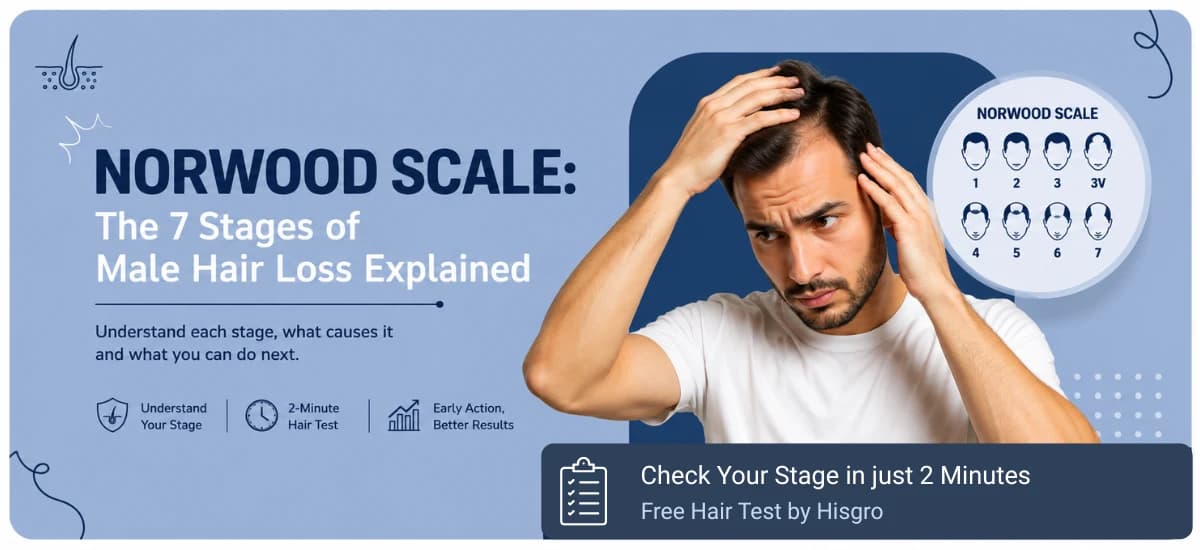
If your hairline looks different than it did five years ago, you're not imagining it. Male pattern baldness doesn't happen overnight it moves through a predictable sequence, and doctors have a name for that sequence: the Norwood Scale.
Knowing your stage matters because the right move at Norwood 2 is very different from the right move at Norwood 6. Catch it early and you're mostly managing DHT and scalp health. Wait until Norwood 5 and you're working with a lot less hair to save.
This guide breaks down all 7 stages, what actually causes the jump from one to the next, and how to figure out where you stand right now including a free 2-minute test that goes further than just eyeballing a chart.
Fact:
Losing 50–100 hairs a day is considered normal turnover, not balding male pattern hair loss is a separate, faster process driven by follicle miniaturization.
Source: NHS
What Is the Norwood Scale?
The Norwood Scale (also called the Hamilton-Norwood Scale) is the classification system doctors and trichologists use to measure the pattern and severity of male pattern baldness, medically known as androgenetic alopecia. It was first mapped by Dr. James Hamilton in the 1950s and later refined by Dr. O'Tar Norwood, whose version is still the standard reference today.
The scale runs from 1 to 7:
- Norwood 1 = no meaningful hair loss
- Norwood 7 = only a horseshoe-shaped band of hair left around the back and sides
Higher number = more advanced hair loss. Every stage in between represents hair loss moving in a specific, recognizable direction first the hairline, then the crown, then the bridge of hair connecting the two.
What Actually Drives the Progression
Male pattern baldness is driven by DHT (dihydrotestosterone), a hormone that gradually shrinks hair follicles that are genetically sensitive to it a process called miniaturization. This is why two men the same age can be at completely different Norwood stages: it comes down to genetics, not just age.
A few things speed up how fast you move through the stages:
- Genetic DHT sensitivity - the single biggest factor, usually inherited from either side of the family, not just your maternal grandfather (a common myth)
- Chronic stress - pushes more follicles into the resting (telogen) phase, compounding pattern loss
- Poor scalp health - product buildup, excess oil, and dandruff can inflame follicles that are already under DHT pressure
- Smoking and poor sleep - both are linked to reduced blood flow to the scalp, which affects follicle health over time
None of these cause male pattern baldness on their own, but they can accelerate a pattern that's already genetically set in motion.
Fact:
By age 30, roughly 30% of men show signs of male pattern baldness, rising to about 50% by age 50
Male Pattern Baldness Stages: Norwood Scale (1 to 7)
Norwood 1: No Visible Hair Loss
Hairline is intact, no thinning at the crown. This is a normal, youthful hairline and isn't classified as balding.

Norwood 2: The "Mature" Hairline
Slight recession at the temples, sometimes forming a subtle widow's peak. Doctors often call this a mature hairline rather than balding it's extremely common and, on its own, not a reliable predictor that further loss is coming.

Why this stage matters most: if male pattern baldness is going to progress, Norwood 2 is the point where intervention has the highest chance of preserving what you have. DHT-blocking actives and consistent scalp care work best on follicles that are miniaturizing, not ones that have already gone dormant.
Norwood 3: The First Stage Considered "Balding"
The hairline recedes further into a clear M, U, or V shape. This is the first stage the Norwood Scale classifies as true balding. Some men also see thinning start at the crown at this stage known as a Norwood 3 vertex.

Norwood 4: Crown and Hairline Both Thinning
Noticeable hair loss at both the crown and the front, usually with a visible band of hair still separating the two areas.

Norwood 5: The Bridge Starts to Break Down
The strip of hair separating the frontal and crown balding areas thins out and narrows, and the two bald patches begin merging into one.
Norwood 6: One Connected Bald Area
The bridge is gone. The front and crown have merged into a single bald area, with hair typically still present on the sides.
Norwood 7: Advanced Hair Loss
Only a horseshoe-shaped band of hair remains around the base of the scalp, from ear to ear at the back.
Fact:
A 2017 genome-wide association study identified 71 genetic loci linked to male pattern baldness, together explaining about 38% of a man's inherited risk
Source: Nature Communications, 2017
Self-Check: Which Stage Might You Be At?
You can get a rough read on your own stage before doing anything else. Answer honestly:
| What you notice | Likely stage |
| Hairline looks exactly like it did a few years ago | Norwood 1 |
| Slight recession at the temples, but no thinning at the crown | Norwood 2 |
| Hairline forms a clear M, U or V shape | Norwood 3 |
| Crown is visibly thinning too, hairline and crown still separated | Norwood 4 |
| The strip between hairline and crown is getting thinner | Norwood 5 |
| Front and crown have merged into one bald area | Norwood 6 |
| Only hair remains on the sides and back | Norwood 7 |
This table is a starting point, not a diagnosis self-assessment from a mirror is notoriously unreliable because you're looking at your own hairline every day, which makes gradual change hard to notice. Hisgro's free hair test takes this further: in about 2 minutes, it factors in your hair fall pattern, scalp condition, family history, and lifestyle to give you a clearer picture of where you stand and what's realistic to expect from treatment not just which drawing on a chart looks closest to your head.
What's Still Reversible, By Stage
This is the part most Norwood Scale guides skip, and it's the part that actually matters for deciding what to do next.
- Norwood 1-2: Follicles are typically still active, just miniaturizing. This is the highest-response window for DHT-blocking routines and consistent scalp care the goal here is prevention, not recovery.
- Norwood 3-4: Hair can often still be maintained and partially improved with a consistent routine, but the earlier you start within this range, the more you're likely to hold onto.
- Norwood 5 and beyond: Follicles in fully bald areas are usually dormant or gone. At this stage, the honest goal shifts from regrowth to slowing further loss in the areas that still have active hair which is exactly why identifying your stage early changes what's achievable.
This is also the point where a lot of hair care advice online oversimplifies things. There's no single product that reverses Norwood 6 back to Norwood 2. What actually helps is matching the right intervention to the stage you're at, consistently, before more follicles go dormant.
Fact:
Incidence roughly tracks age by decade about 20% of men in their 20s, 30% in their 30s, 40% in their 40s show signs of MPB
Source: International Society of Hair Restoration Surgery (ISHRS)NHS
Track It, Don't Just Guess
The most useful thing you can do isn't memorizing which stage number matches your hairline it's tracking whether it's changing. Take a photo of your hairline and crown every few months, in the same lighting, and actually compare them side by side.
If you notice movement, or you just want a clearer answer than "does this look like an M-shape," start with the free Hisgro hair test. It takes about 2 minutes and gives you a personalized read on what's actually going on with your hair and scalp so instead of guessing your Norwood stage, you know it, and what to do about it.
Free Hair Test | Check Your Hair Loss Stage
Follow 3 simple steps to understand your hair fall, discover your exact hair stage, and get a doctor-designed regrowth plan.
Take the FREE Hair Test
Answer a few questions and upload your hair photos.
Discover Your Hair Stage
Get your hair stage and personalized assessment report.
Follow Your Hair Plan
Get personalized recommendations for your hair needs.