

If you've tried three different anti-dandruff shampoos in the past year and none of them worked for more than a few weeks, the shampoo probably wasn't wrong for your hair. It was wrong for your type of dandruff.
Dandruff isn't one condition. It's at least three, and each one responds to a different active ingredient. Research puts dandruff among the most common scalp conditions worldwide, affecting roughly half of adults at some point, so needing a fix for it is normal, not a sign something is badly wrong. Before you pick up another bottle, it helps to know exactly what you're dealing with, and browse our full range of men's hair care products to find something formulated for your actual scalp type instead of a generic fix.
Most anti-dandruff shampoos on the shelf are formulated for one cause, usually oily or fungal dandruff, since that's the most common type. That's why people with dry scalp dandruff often say their flakes get worse, not better, after a few washes. The formula is stripping moisture the scalp actually needs. Matching the treatment to the type is the difference between a clear scalp in two weeks and flakes that keep coming back for months. For the basics of keeping the rest of your scalp and hair in shape alongside this, our hair care tips for men guide is a useful starting point.
The 3 Main Types of Dandruff
| Type | What the Flakes Look Like | How Your Scalp Feels | What's Actually Happening |
| Dry Scalp Dandruff | Small, white, powdery flakes that fall away easily | Tight, itchy, sometimes flaky elsewhere on the body too | The skin barrier loses moisture; flaking is a dryness response, not a yeast issue |
| Oily (Seborrheic) Dandruff | Larger, yellowish, greasy flakes that stick to hair and scalp | Feels oily again within a day of washing | Excess sebum feeds Malassezia yeast, speeding up skin cell turnover |
| Fungal Dandruff (advanced seborrheic dermatitis) | Yellow or reddish, oily scales, sometimes visible redness | Persistent itching or mild burning, may spread to eyebrows or hairline | Malassezia overgrowth becomes chronic and inflammatory rather than mild flaking |
MYTH
Dandruff happens because you don't wash your hair enough.
Dandruff is closely linked to an overgrowth of a yeast called Malassezia interacting with scalp oil, not simply a hygiene issue, which is why even people who wash daily can still deal with flakes. It's also not equally common across every hair and skin type: a 2025 clinical review found dandruff prevalence ranging from 81 to 95% in African American populations and 66 to 82% in Caucasian populations, down to 30 to 42% in Asian populations.
Source: SageJournal
That's worth knowing if your dandruff looks milder or drier than what's described in most international content aimed at other hair types.
How to Tell Which Type You Have
- Flakes are small, white, and powdery, and your scalp (or skin elsewhere) feels tight → dry scalp dandruff
- Flakes are larger, yellowish, and cling to your scalp or hair → oily/seborrheic dandruff
- You have redness, ongoing itching, or flaking that spreads past the scalp → likely advanced seborrheic dermatitis, worth a dermatologist visit
- Flaking gets worse after a heavy, moisturizing shampoo → points to oily/fungal dandruff
- Flaking gets worse after a strong clarifying or medicated shampoo → points to dry dandruff
Treat-by-Type: What Actually Works
- Dry scalp dandruff: Look for a mild, moisturizing shampoo with gentle exfoliants like salicylic acid, follow up with a lightweight conditioner, avoid hot water, and cut back on daily washing so the scalp doesn't dry out further.
- Oily/seborrheic dandruff: Look for actives like zinc pyrithione, ketoconazole, or selenium sulfide. Let the shampoo sit on the scalp for a few minutes before rinsing, and wash more frequently rather than less.
- Advanced/fungal dandruff: If flaking comes with redness, thick scaling, or spreads to the eyebrows or hairline, over-the-counter shampoos alone often aren't enough. A dermatologist can prescribe a stronger antifungal or steroid-based treatment.
The right active ingredient makes a measurable difference. In a controlled trial of 246 people with moderate to severe dandruff, a 2.5% selenium sulfide shampoo cut dandruff scores by 66.7% over 29 days, compared to 44.5% with a placebo shampoo, and 54.7% of users saw their scalp rated clear or nearly clear versus 28.6% on placebo, a statistically significant gap.
Source: PMC
When Dandruff Starts Affecting Your Hair Fall
Dandruff on its own doesn't cause hair fall. But constant itching leads to scratching, and repeated scratching can irritate hair follicles and weaken the roots around them over time. If the underlying cause is chronic seborrheic dermatitis rather than simple dryness, the ongoing inflammation can also affect the scalp environment your follicles sit in.
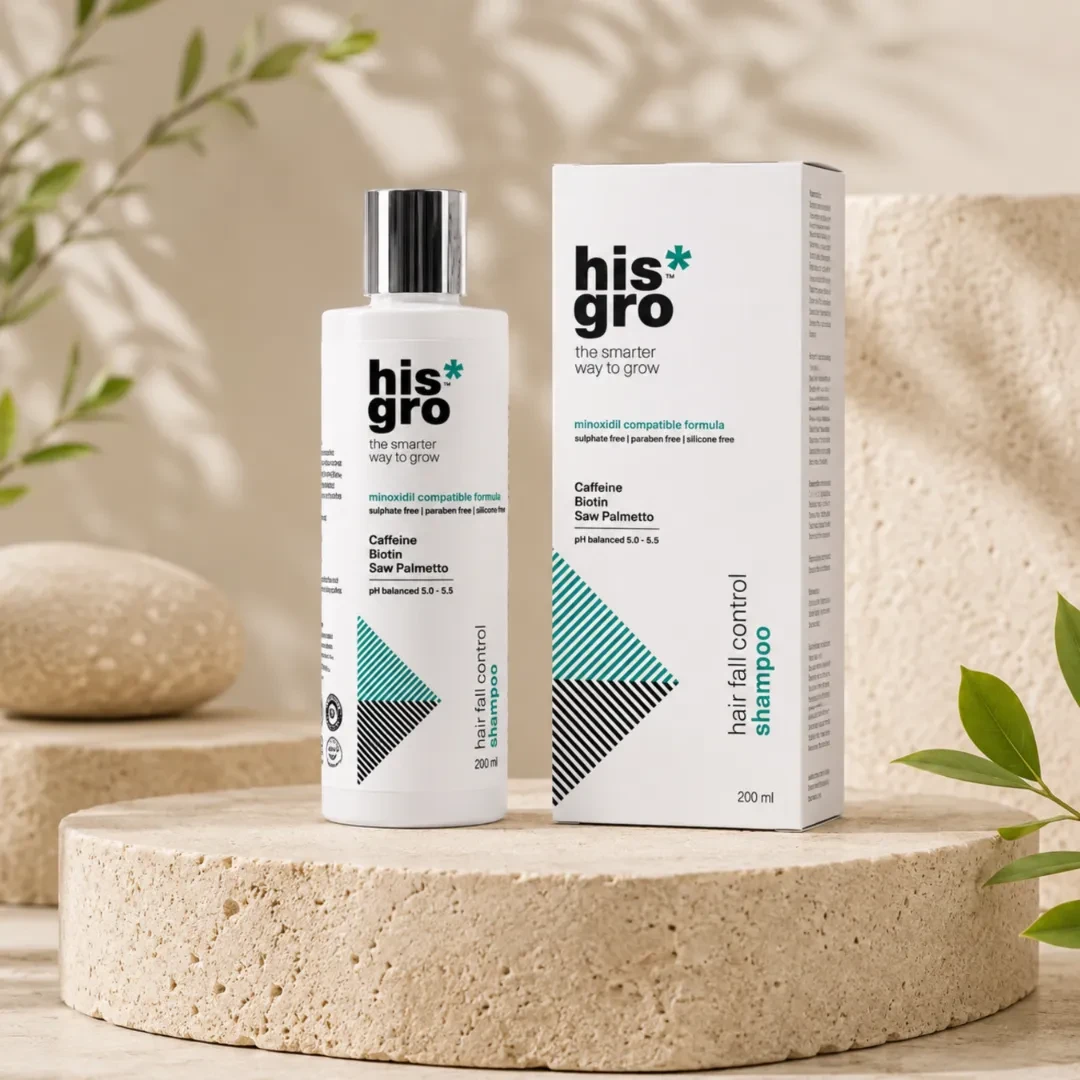
If you've noticed more strands in the shower along with flaking, it's worth switching to a scalp-friendly anti-hair-fall shampoo that calms the scalp while addressing shedding, rather than one built only for cosmetic flake control.
Dandruff is just one of several triggers behind hair fall in men. If flaking is compounding hair that already looks thinner or finer than it used to, it's worth reading our guide on how to increase hair density naturally alongside sorting out the scalp issue, since the two often need to be tackled together.
The right fix depends on whether your hair fall is scalp-driven, hereditary, or linked to a different stage of loss altogether. Take the free Hisgro Hair Test to get a personalized read on your scalp and hair fall stage before you commit to a routine.
What Else Gets Mistaken for Dandruff
Not every flaky scalp is dandruff. Scalp psoriasis is the condition most commonly confused with it: psoriasis tends to show up as thicker, more defined patches with silvery scaling, and can extend past the hairline to the forehead, neck, or behind the ears, unlike dandruff. It's also an autoimmune condition rather than a yeast-driven one, so it usually needs a dermatologist's treatment plan rather than an OTC shampoo. Plain dry skin, eczema, and product buildup from styling products can also look like dandruff without any yeast involvement at all.
Worth knowing if you're in India specifically: the more advanced, inflamed form of dandruff (scalp seborrheic dermatitis) is less common here than the global average. A 2024 meta-analysis covering over 1.26 million people across 121 studies found a global pooled prevalence of 4.38%, versus just 2.62% in India, the lowest of any region studied.
Source: PubMed
So if your flaking comes with real redness, thick scaling, or inflammation rather than plain flakes, it's worth a dermatologist visit rather than assuming it's routine dandruff. If flaking doesn't respond to a correctly-matched shampoo after four to six weeks, that's also the point to get it checked rather than switch shampoos again.